Concussion Recovery
There’s been a lull across the board with this site, marketing, updates and content for a few months, and it’s probably important to acknowledge why.
I got hit by a car in February. My helmet is entirely intact and didn’t quite get a chance to do its job, because in my attempts to avoid the car I managed to smack my face off the side of it instead of my head. You can read a bit more on what happened that day HERE if you want to.
I didn’t have the obvious concussion symptoms initially, they took a few days to really set in. In hindsight they were probably there sooner than I recognised but it’s hard for your brain to identify when it isn’t running the way it should be, especially when you’re an athlete.
I’ve had two friends who have also suffered concussions in the past two months who have been in touch for advice on everything from what to look out for to what helped and what didn’t in terms of recovery. I’ve seen several other athletes talk about hitting the deck or taking knocks to their helmets since I crashed too, and often racing again far too quickly in my opinion.
So, here’s a variety of things I’ve done and learned over the past four-ish months that might be helpful to any endurance athlete who ends up with a longer term concussion.
First of all, if you crash, hit your head and get knocked out or don’t remember what happened, go to the hospital. Helmet or not, go get a scan, it’s your brain.
If you’ve crashed you can get a concussion from body impact and not just head impact although it is less common. These are the symptoms you should be looking out for, and someone else close to you should be looking out for them too.
There is an off-field assessment you can take called a Scat5 which is helpful in monitoring your symptoms and the severity of them. It’s a tool, not a cure. However, for an endurance athlete whose brain isn’t functioning 100% the question of fatigue should be highlighted. While the answers are subjective, it’s probably helpful to have someone close to you there when you’re answering some of them.
For example, I answered 2 out of 6 about 10 days post crash for fatigue. In some ways, my body felt great. That’s because I’d gone from 400ish km a week on the bike to full rest. My brain had also forgotten the day before I had slept for 11.5 hours, gotten up for breakfast and then needed a nap. Two days later I had to take a nap on a friend's couch after a wander around the park. I was still putting fatigue down as a 2 out of 6.
Symptoms can take over a week to show up, you’re not out of trouble after 48 hours.
There is a protocol for returning to the bike.
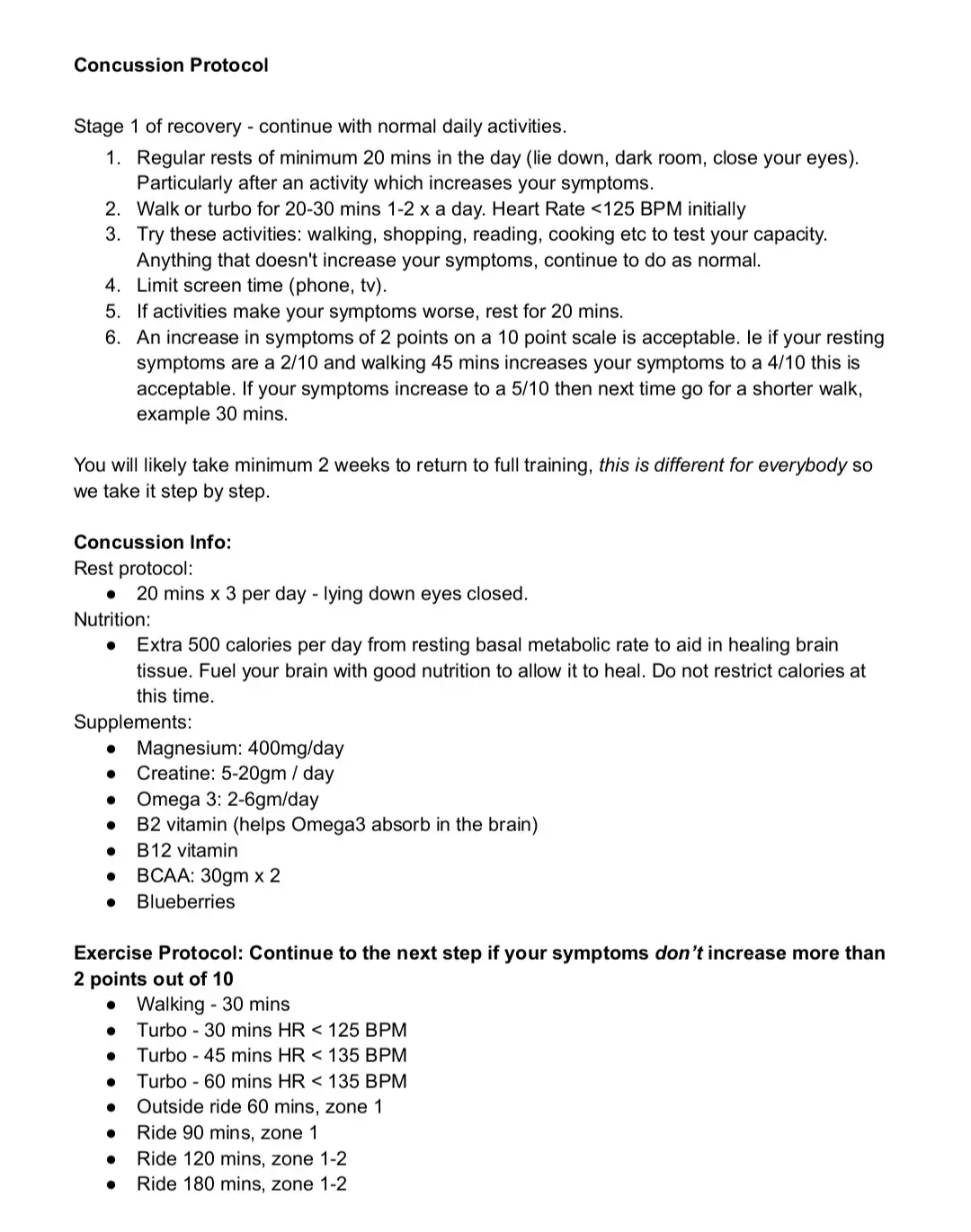

However, it’s not guaranteed to be smooth sailing through the protocol. I was over 12 weeks trying to get to 45 minutes under 135bpm without it exasperating symptoms.
So here are some more things I learned during that time.
Sleep.
Sleep when you need to at the start. People talk about making sure you’re able to sleep at night, but during the early stages my opinion is to let yourself sleep when you need to. Some people struggle to sleep when they’re going through a concussion and unfortunately I don’t have any advice for you if that’s what you’re experiencing, but the advice I do have is to sleep when you need to.
Plan to nap every day. You can regulate your sleeping pattern again when you’ve recovered.
Your brain needs deep sleep to recover, if you have a way to track that then do.
Food.
Eat more carbs. Your brain needs simple sugars for fuel and it’ll want more of them. If you’re craving sugar, eat it. It’ll help you heal faster. You need so much more fuel in recovery. I bonked on a walk in the park a few weeks in. Initially I thought I was getting dizzy, then I realised I’d had that exact feeling on the bike before when I’d run out of food. I left the park and went to a bakery, problem solved. Lesson - eat more, and eat more carbs. If you’re an endurance athlete worried about your weight, stop. It’s easier for you to recover and then work on your body composition than it is to try and keep your body at a certain weight while you recover.
Supplements.
Creatine. Creatine is phenomenal for brain fog. I had some incredibly foggy days. I was briefly convinced we’d a problem with our stove because none of the rings would light - I was 10 weeks into this nonsense by this stage. Turns out I was holding up an unlit match beside each of the hobs trying to light them. Creatine will help clear the fog.
I also started taking omega oils, B12, and magnesium and potassium. Added to everything else I did, they were helpful, although not as standout in the difference as Creatine. Did I mention you should take creatine?
Progress.
It is far from linear with concussion. There will be moments when you feel great, or even just normal again, and you’ll think you’ve been gaslighting yourself. Then those good moments will likely pass again and you battle this strange feeling of relief that you haven’t been gaslighting yourself, but frustration that it was just a break from the rest of the symptoms.
“Protocol”.
This was hard. I was given the above concussion protocol by my physio, and was given an identical one from a friend who works with the Specialized Off-Road team. It starts with a half hour riding on a trainer under 125bpm as step one. I couldn’t manage that initially. I could lift some light weights though. I ended up giving a handful of swimming lessons which encouraged me to get back in the pool (something I spent years of my life doing) and that had no ill effects. So I was told to keep my heart rate under 130bpm and do some hiking/jogging. Again, no major issues.
I went to the beach with a friend in the car and felt car-sick the whole way there and back. This seemed like an ah-ha moment in some ways, so we worked on some specific issues for that and I was able to take on step 1 of the protocol. Again. Step 2 didn’t really work though - 45 minutes under 135 bpm. An important piece of insight might be to consider that my max heart rate in 2024 was 208, so 135bpm is really not a lot for me. Riding a bike didn’t seem to be as simple as riding a bike.
Triggers.
This might have been one of the most important things I did.
I hit 12 weeks and my symptoms were lower than they had been but not low enough to get to step 2 on the protocol without issue. My physio had been great, but at 12 weeks she did tell me I needed to seek out help from a doctor as we were now entering post concussion syndrome territory. I did this, we had a follow up MRI etc. but one of the best things I had done in the 12 weeks was talk to different endurance athletes who had suffered concussion or TBI’s and ask them what they had experienced.
Did you know there are apparently 6 different types of concussions? Different types have different triggers. Mine is exertion. I had some vestibular issues early on but the different eye tracking exercises seemed to resolve that - and yep, I did sit in my room with a laser beam on my head making shapes on the wall and following it with my eyes… However, it became obvious in time that the main problem for me was, and still is, a high heart rate.
I had crossed paths with a pro-cyclist in the last year or so who was suffering with concussion whose main issue was on the bike. Normal life activities seemed to come back much quicker. He was out of racing for over a year but is back in action at World Tour level this year. I hadn’t thought too much about it at the time, but I eventually reached out.
Based on the phone call we had, I restarted on the bike after a quick chat about this plan with my physio.
I had ridden once or twice in the past 12 weeks, every now and then thinking I feel better, it’ll be fine - spoiler, it was not. But I knew below 120bpm I was OK. So I rode 20 minutes at 120 bpm on the trainer in my room. I needed a nap an hour later, and then I rode another 20 minutes at the same intensity that evening. I started to rebuild from there, and any time I push past what I’ve previously done I make sure I have a nap afterward before I do much else. I don’t always feel tired but the 20-30minutes with 0 stimulus provides some type of recovery that I can’t explain. Sometimes I would close my eyes but they would seem to keep moving behind my lids. I imagine it’s what they look like when you’re in REM sleep, it’s weird but the 20-30 minutes was definitely still necessary.
I’m currently able to ride for 3 hours at lower intensities and have done a few reps of up to 3 minutes at 180bpm. It’s taken nearly eight weeks from restarting with two 20 minute sub 120 heart rate rides on the trainer to get to that point, and I expect it to take another four to six to get me to where I was at the end of my extended off-season.
In terms of my triggers and the protocol, what this meant is that I needed to have step 1.1, 1.2, 1.3… It took me nearly two weeks to build up to step 2.
Final Points
If you’re an athlete, sport specific recovery is required. I was sent a lot of information on rugby, that’s great but I didn’t intend on running into anyone at pace any time soon so while there were nuggets in some pieces it wasn’t hugely beneficial.
A brain injury is shit, simple as, especially because you need to use your brain for so many things, along with helping you plan and carry out your recovery. Doing absolutely nothing is also detrimental to your recovery after an initial post crash rest period too, so it’s a shit injury and progress is often far from linear.
Get professional help. You can’t rehab this injury solo.
Get a colouring book and some pencils and download some good podcasts.
If you’re suffering from a longer term concussion, get a notebook and keep track of the things you are doing day to day, and whether you’ve had low or high symptoms that day. It might seem frustrating at the start but over time the list grows and the symptoms reduce.
Naps are considered productive.
Eat more ice cream.